
Towns County Owner Record Card
The Towns County qPublic assessment route is the practical first check. The Owner field names the party on the published roll. Field order can shift. Transcribe what the current parcel card actually shows instead of trusting an assumed layout.
| Owner Name | The person, joint owners, estate, trust, LLC, or public body listed on the roll |
|---|---|
| Mailing Address | Where the assessor sends owner notices, not where the parcel must be located |
| Situs Address | The physical location used to identify the Towns County parcel |
| Last Sale Date | An assessor sale clue that needs deed confirmation |
| Deed Reference | A book/page or related recording clue, when displayed |
The owner of record is not the occupant. A mailing address may belong to an office, an attorney, a bank, or an owner far away. Vacant land can even show a blank situs. Preserve both fields, and never use one as a shortcut for the other.
Time the Towns Owner Record
Towns qPublic says it reflects the most current published tax digest. The county did not publish its typical deed-to-roll lag. Georgia values property as of January 1, so a transfer later in the year may appear in the deed index before it reaches the assessment roll. Write down the date searched and any upload or digest date displayed.
A current owner conclusion should state its source: current on the assessment roll as of the search date, or latest recorded grantee as of the deed search. Those are precise claims. Saying that one person owns the land today without a date or source is not.
Check the newest deed. The assessment roll can lag a recent sale. When the parcel matches, the latest recorded conveyance is the more current ownership clue.
Confirm Towns County's Current Owner
Verification pairs the roll with the Clerk's recordings. Skip the chain of past owners here. The goal is finding the newest deed conveying the parcel and checking whether its grantee matches the roll.
- Search the physical address in qPublic and copy the full parcel number and Owner field.
- Search that owner in the GSCCCA Real Estate Index with County set to Towns.
- Open the newest deed and match its grantee, legal description, book/page, and recording date to the parcel.
- Call the Assessor or Clerk when the parcel matches but the dated owner names differ.
- Owner of record
- The party named on a dated official record, such as the assessment roll.
- Assessment roll
- The county's tax valuation register, which also carries the assessor's owner name.
- Situs address
- The parcel's physical location, distinct from the owner's mail destination.
- Recording lag
- The time between a deed filing, indexing, and a later assessment-roll update.
Towns Current Owner Search Entry
The Towns assessor search entry is the county's address-to-owner handoff. Search by address first. Then save the parcel ID it returns. If the portal will not load, the Assessor at 706-896-3984 can search by physical address, owner, subdivision, lot, or parcel reference.
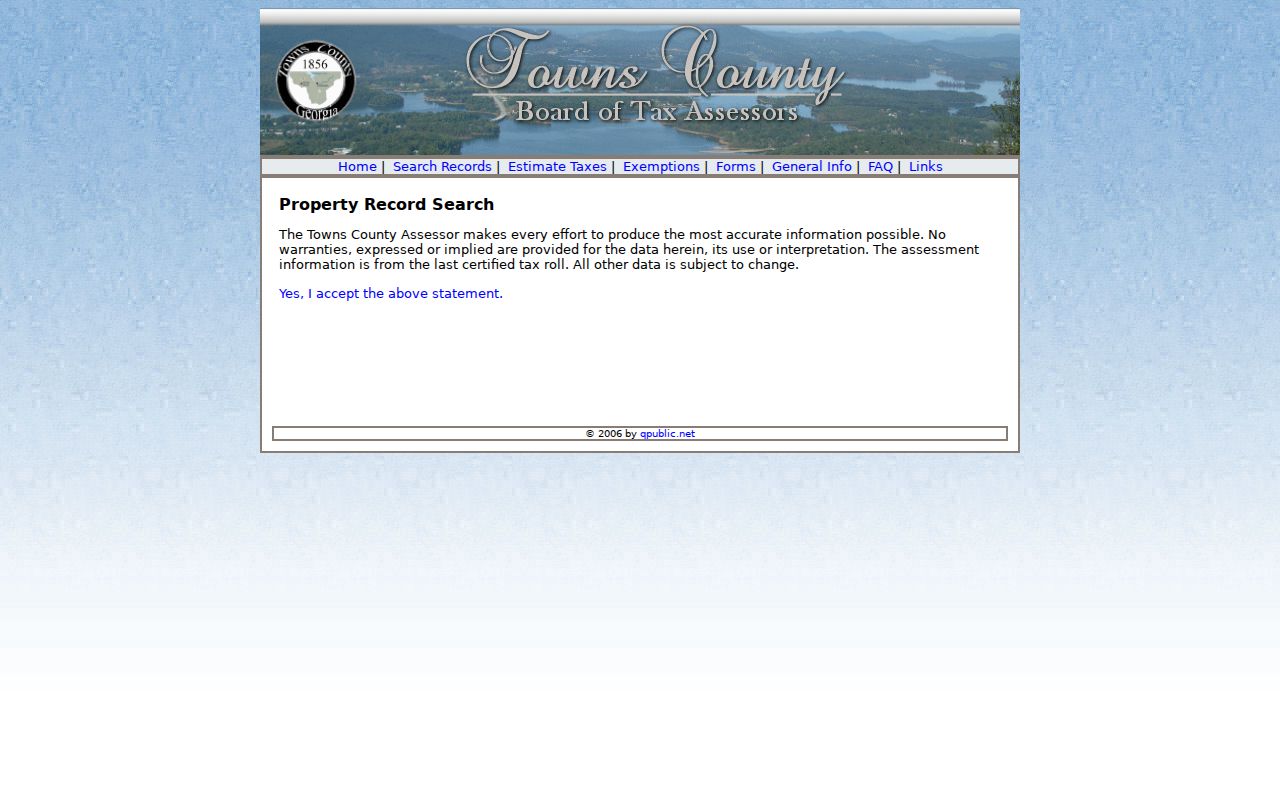
The image shows the official Towns County owner search entry point rather than any sample parcel owner. No private owner information appears.
Resolve Towns Owner Name Differences
A mismatch is not always an error. A recent recording, estate administration, survivorship affidavit, trust transfer, spelling variant, or parcel split may explain it. Compare the legal description first. A matching street address alone is weak evidence, since roads and 911 addresses change.
The Tax Assessor keeps the roll from Suite G at 48 River Street. The Clerk keeps deeds and plats in Suite E. Ask each office which dated source it used. Corrections to the roll follow the assessor's process. Recording questions go to the Clerk's index and document image.
Parcel identity comes before the owner name. Compare acreage, land lot or district, subdivision, lot, road or water reference, and any prior deed citation. A street address is a locator only. The legal description is the steadier link. After a split or merger, ask the Assessor for the old and new parcel numbers and look for the recorded plat that explains the change.
Tax data adds timing context and nothing more. The Tax Commissioner sets neither ownership nor value. A name on a tax bill should never overrule a newer recorded deed. Keep tax, assessment, and recording dates in separate fields so one office's annual cycle is not mistaken for another's filing date.
Towns County Trusts and LLCs
An owner field can name an LLC, a corporation, a trustee, an estate, or heirs. Keep that wording intact. The Georgia corporations search can show an entity's status, control number, registered agent, and officers. None of that proves personal ownership of the parcel.
Trust and estate names take more work. Towns Probate sits at 48 River Street, Suite C. The deed language and a related probate record may be required, and a will or obituary adds context without replacing the conveying deed.
Towns Filing Alerts Have Limits
The free GSCCCA FANS system sends notice based on a registered name, address, or document criterion. It only looks forward. It depends on clerk-indexed data. It expires in one year. It never finds filings made before enrollment. Towns County has no local equivalent. A FANS notice can prompt a fresh current owner check. But it cannot establish title or promise complete coverage. Renew as needed. Use it only for property you own or are authorized to watch.
Check Towns Owner Information Lawfully
The tax roll's mailing address counts as public owner-of-record data. Even so, it may not be a home address. Treat it as a way to route a legitimate parcel question. Keep any contact brief and tied to the property. Guessing who lives at the situs crosses a line no property search justifies. So does publishing sensitive details.
Georgia law lets records offices redact Social Security numbers, financial data, medical information, parts of birth dates, and certain protected addresses. A current owner search does not defeat those protections. It also cannot replace a title examination when a sale or dispute is at stake. For the wider address-to-owner route, see the Towns County property owner method. For the present record, the dated roll and latest deed remain the anchors.
When the online route stalls, the Tax Assessor can search by physical address, owner, subdivision, lot, or a known parcel reference. The Clerk handles deed searches by party, book and page, and legal-description clues. A Georgia Open Records request is another lawful path to an existing public file. It should ask for records rather than a fresh title analysis. Ask for a cost estimate first if the search could run broad.