
Three Towns County Property Value Measures
Start by naming the figure. Towns County property value research otherwise compares unlike numbers. The Board of Tax Assessors determines fair market value on the assessment roll. Georgia applies a 40 percent assessment ratio. A sale price instead comes from a recorded transfer and may reflect a different date, condition, or bargain, while the assessed figure drives the annual tax bill.
| Value | What It Is | Where |
|---|---|---|
| Fair market value | The assessor's estimate of full value for the annual digest | Towns County Tax Assessor record |
| Assessed value | Forty percent of fair market value before exemptions and other tax adjustments | Assessment roll and tax calculation |
| Last sale price | The reported consideration from a prior transfer, tied to that transaction and date | Parcel-card sale entry and recorded deed |
| Component values | Separate land, improvement, and accessory amounts that make up the record | Towns qPublic parcel card |
The assessed figure is not the sale price. That distinction trips up plenty of owners. A $100,000 fair market value yields a $40,000 assessed value before exemptions, though the actual tax still depends on the applicable millage and taxable adjustments. The sale figure records an event; the assessment figure serves the yearly tax roll.
Towns County Property Value Splits Land and Buildings
An assessor record can split a parcel's total. Land value stands apart from improvement and accessory value. Improvements generally mean the main buildings, while accessory entries capture other valued features on the parcel. Keeping those parts separate explains why two parcels with similar acreage carry different totals. It also shows why a parcel changed after construction. Copy the component labels and tax year exactly. A blank or changed entry should be checked with the Towns County Tax Assessor at 706-896-3984 rather than read as proof that a structure exists, was removed, or was permitted. Permit and inspection records are a different evidence layer. The Towns qPublic landing page marks the official assessor route for parcel and value lookups. Value fields on that page come straight from the assessment roll.
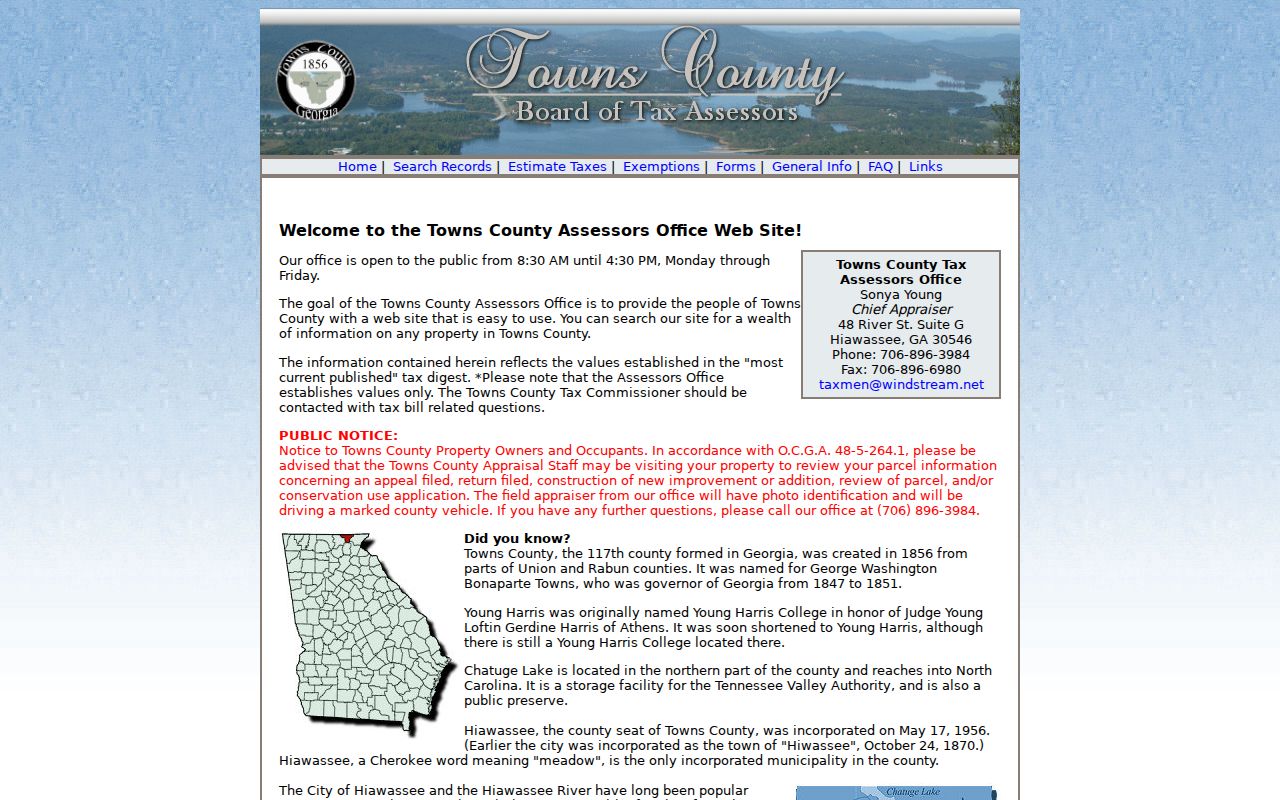
That page confirms where the numbers live. Each actual value still needs to be read from the current parcel result and matched to its tax year.
January 1 Anchors Towns County Property Value
Georgia law fixes January 1 as the assessment date for property. Keep that anchor in mind whenever you compare a Towns County assessed value. A sale, renovation, or demolition may have happened later. The roll only reflects conditions at the start of the year. Two official numbers can both be right for their own dates. They may still differ sharply.
The published qPublic language describes the current digest. Towns County has not published an exact deed-to-roll refresh schedule. So a deed recorded right after a closing may be newer than the owner. It may be newer than the sale data too. Keep the year beside every number you save. Confirm any transfer in the deed index.
Check a Towns County Property Value by Address
A focused value lookup starts with the physical address. The parcel number then keeps the assessment and the deed tied to the same land. This path reads value fields only.
- Open the Towns qPublic search route and enter the situs, meaning physical, address. If the format fails, try the street without a directional or suffix.
- Confirm the parcel number, acreage, and map reference before copying fair market, assessed, land, improvement, and accessory values.
- Record the tax year and January 1 context. Do not mix that figure with a sale or tax payment from another date.
- Read the last-sale fields as a lead, then confirm the price, parties, and legal description in the latest recorded deed when the comparison matters.
- Ask the Assessor about an unexplained component or year. Use the Tax Commissioner only for the resulting bill, payment, or balance.
- Fair market value
- The assessor's full-value estimate used to build the annual digest.
- Assessed value
- The statutory percentage of fair market value used before exemptions and other adjustments in the tax calculation.
- Assessment ratio
- The share of fair market value assessed for tax purposes. Georgia uses 40 percent for this calculation.
- Consideration or sale price
- The amount associated with a recorded transfer, which should be read with its deed date and terms.
- Reassessment
- A new determination of value for the tax roll, not a private appraisal made for a transaction.
Confirm Towns County Property Value Sale Data
A parcel card's last-sale entry is useful context. It should not stand alone. Search the owner name or book and page through the GSCCCA Real Estate Index, which covers every Georgia county from at least January 1, 1999 while historic data continues to be added.
The deed can show the grantee, recording date, legal description, and consideration clues connected with the transfer. Consideration is only a clue. Not every deed reflects an open-market price. A family conveyance, gift, quitclaim, estate transfer, foreclosure, or multi-parcel deal may tell a different story. Match the land description before comparing the number.
Note: Recording date, deed execution date, and assessment date are distinct, so keep all three whenever a recent transfer affects the comparison.
Towns County Property Value and Exemption Differences
Exemptions change what Towns County records show. Homestead, senior, veteran, and conservation programs can affect the taxable or net figure, but they do not rewrite what a prior buyer paid. Taxable value is not market value. Keeping them apart prevents a low taxable figure from being misread as the home's likely price. For exemption details or an assessment question, contact the Assessor at 48 River Street, Suite G, Hiawassee. Use the Tax Commissioner for balances and payments. Neither office replaces the other. The full bill, exemption, and appeal process belongs with the Towns County property tax records, because those steps answer a tax question rather than value meaning.
Young Harris Planning Can Inform Towns County Property Value Research
Young Harris approved a master plan on November 6, 2024, and its July 2025 zoning map reflects an April 1, 2025 amendment. The map lays out city districts. It also marks Young Harris College overlay zones. Development references like McTyeire Crossing, the Powerhouse Center, Valley Trail, and bypass work may prompt research into plats, easements, zoning, permits, or parcel splits. Planning records set no Towns County property value. Each record answers its own question. Compare the dated city material with the assessor roll and the recorded instruments. A public announcement is a lead, not evidence of a completed transfer, a new parcel, or a price increase.
Towns County Property Value Offices Have Different Roles
Towns County splits its property tax work between two offices. The Board of Tax Assessors sets the assessment value. It also rules on exemptions, conservation applications, and returns. The Tax Commissioner handles the money side: billing, collecting, and disbursing the tax. Neither duty belongs to the other office. The Tax Commissioner has no say over fair market value, assessed value, or millage.
Where should you turn? Take a valuation dispute or a wrong classification to the Assessor. Take bill amounts and payment history to the Towns County tax portal. Keeping the duties straight matters. A paid bill is not the same as accepting the valuation behind it.
Limits of a Towns County Assessor Value
An assessor value in Towns County is a mass-appraisal figure, built to spread the tax load fairly across every parcel on the tax roll. It is not a price tag for a specific sale. Markets move, property condition varies, and the assessment date can fall well before a sale or an improvement, so the number can drift from what a buyer would offer. A parcel map, tax notice, listing, or development announcement cannot stand in for a property-specific appraisal either.
Value is not price. An assessed value supports taxation and does not promise what a Towns County property would sell for. Obtain a licensed appraisal when a current market opinion is required.
Property records still earn their keep once you respect their limits. Cite the parcel, the value label, the tax year, the source, and the lookup date, and anyone can recheck the same figure after the digest changes.